Foundations
Deeper
Frontier
Transcript and shot list
Draft material
From wordpress-export/pages/formation-of-stars.md
Formation of Stars
Formation of Stars
The First Stars
In this section, we will learn how the first stars were formed out of the primordial hydrogen and helium gas that existed in the early universe. We will learn how as the universe expanded and cooled, small density fluctuations in the gas caused it to collapse under its own gravity. This collapse led to the formation of dense regions called “protostars.” As the protostars continued to collapse, their cores became hot enough for nuclear fusion to begin, at which point they officially became stars.
Section Preview: A 3D schematic of a galaxy
13.8 billion years ago
The Big Bang
From something unbelievably tiny, unbelievably dense, and incredibly hot, suddenly, space, time, and all molecular matter burst in ways that no words can express. The Universe expanded at an unfathomable rate in a fraction of a second. Some recognised subatomic particles and fundamental forces emerged as a result of this expansion. The Universe then began to cool drastically, to around 1 billion degrees Celsius, allowing energy and ultimately matter (plasma of nuclei, electron and photons) to emerge.
3,80,000 years after The Big Bang
Cosmic Microwave Background (CMB)
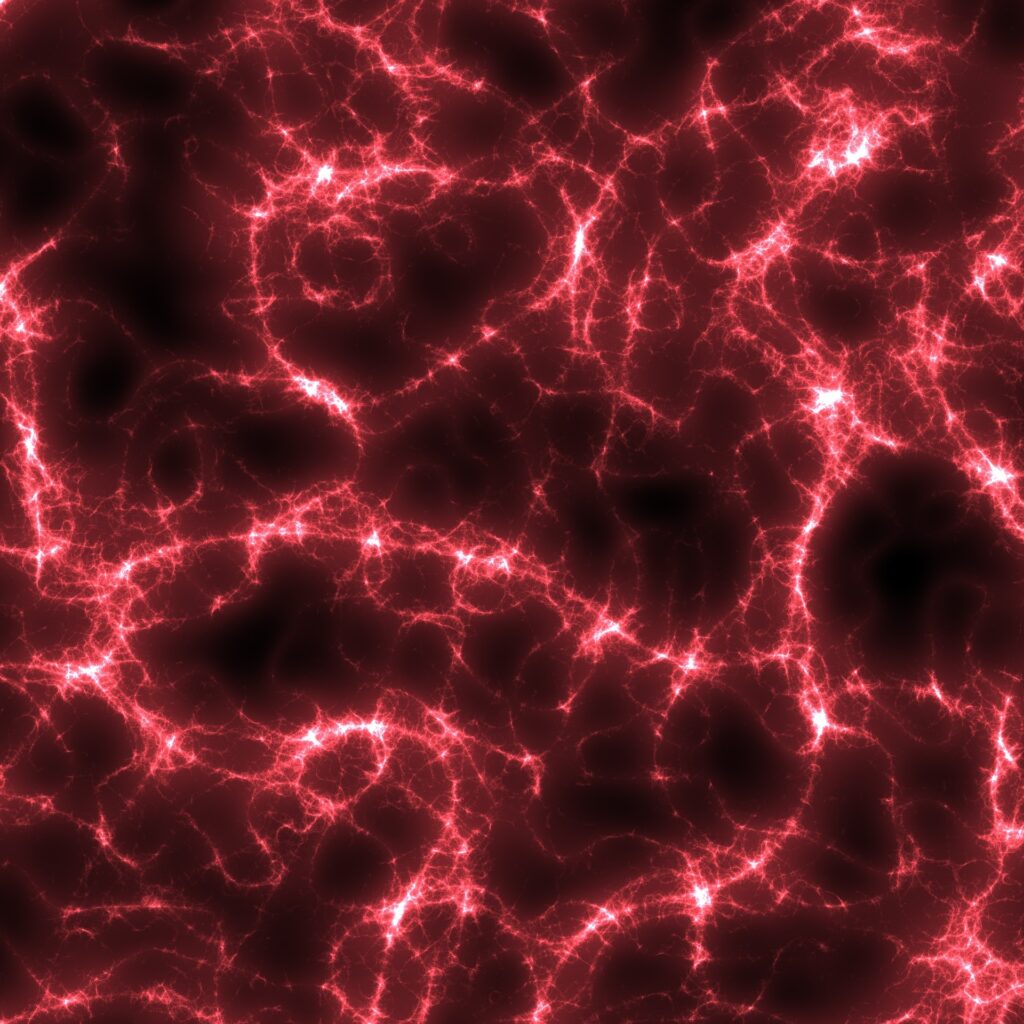
As the universe expanded, plasma grew cooler and cooler. The universe cooled down further to 3000 K, making it possible for the nuclei in the plasma to gain electrons and become full-fledged neutral Hydrogen and Helium atoms.
**Photons **of light tangled in the plasma could now move freely and were released. The universe became transparent for the first time. This is known as cosmic microwave background that we can see even today.
Cosmic Dark Age

The entire universe consisted of Hydrogen and helium gas clouds with no stars or planets.
After the release of CMB, nothing in the Universe radiated light until around 200 million years after the Big Bang when the first stars began to form.
The cosmic “dark age” is a term used to describe the period of time in the early universe when the first stars and galaxies had not yet formed, and the universe was largely dark and diffuse. This period is thought to have occurred between the end of the cosmic “dark ages” and the formation of the first stars, which occurred around 150 million years after the Big Bang.
During this time, the universe was primarily composed of hydrogen and helium, with small fluctuations in density. As the universe expanded and cooled, these density fluctuations led to the collapse of small regions, forming the first generation of stars, called population III stars.
It’s important to note that during this time, the universe was still mostly dark, as the first stars were not able to produce significant amounts of light. It wasn’t until the formation of the first galaxies, when the first massive stars began to form and eventually die in supernovae explosions that the universe began to light up and the cosmic “dark age” came to an end.
About 200 million years after The Big Bang
First Stars
Due to gravity, hydrogen and helium clouds began to clump together. Tiny imperfections. Little knots, wrinkles, and flaws began attracting nearby particles of matter. The clumps grew, became more massive, and attracted more particles. Hence, it made them denser, and as a result, gravity became more intense. As the clouds compress more and more, they became hotter, until the center became so hot that nuclear fusion began. This released a tremendous amount of energy, which caused the earliest stars to light up. The gravity that was trying to squash the star together was pushed back by the fusion at the center which created a balance. Within a few hundred million years after the Big Bang, the first generation of stars, known as Population III stars, were formed. After CMB, these stars were the first source of visible light in the universe.
About 1 Billion years after The Big Bang
The First Galaxies, clusters and superclusters
Stars formation happened almost everywhere in universe. Thus we have billions and billions of stars. Galaxies were formed out of these swirling clouds of stars and gas in space. Gravity sends these objects careening into one another as other clouds approached, knitting them into larger spinning packs. Material can be slung toward a galaxy’s outskirts following collisions, forming large spiral arms filled with star colonies. Since, these were large scale structure it took a long time in an almost homogeneous gas clouds.
wHAT’S bEFORE?
The Beginning
wHAT’S NEXT?
Chemicals cook up
From wordpress-export/posts/formation-of-stars-timeline.md
The First Stars
In this section, we will learn how hydrogen and helium atoms clumped together to form the first stars and first galaxies of the Universe. We will discuss the following:
- Cosmic Dark Age
- Formation of First Stars
- First Galaxies
Section Preview: A 3D schematic of a galaxy
13.8 billion years ago
The Big Bang
From something unbelievably tiny, unbelievably dense, and incredibly hot, suddenly, space, time, and all molecular matter burst in ways that no words can express. The Universe expanded at an unfathomable rate in a fraction of a second. Some recognised subatomic particles and fundamental forces emerged as a result of this expansion. The Universe then began to cool drastically, to around 1 billion degrees Celsius, allowing energy and ultimately matter (plasma of nuclei, electron and photons) to emerge.
3,80,000 years after The Big Bang
Cosmic Microwave Background (CMB)
As the universe expanded, plasma grew cooler and cooler. The universe cooled down further to 3000 K, making it possible for the nuclei in the plasma to gain electrons and become full-fledged neutral Hydrogen and Helium atoms.
**Photons **of light tangled in the plasma could now move freely and were released. The universe became transparent for the first time. This is known as cosmic microwave background that we can see even today.
Cosmic Dark Age
The entire universe consisted of Hydrogen and helium gas clouds with no stars or planets.
After the release of CMB, nothing in the Universe radiated light until around 200 million years after the Big Bang when the first stars began to form.
About 200 million years after The Big Bang
First Stars
Due to gravity, hydrogen and helium clouds began to clump together. Tiny imperfections. Little knots, wrinkles, and flaws began attracting nearby particles of matter. The clumps grew, became more massive, and attracted more particles. Hence, it made them denser, and as a result, gravity became more intense. As the clouds compress more and more, they became hotter, until the center became so hot that nuclear fusion began. This released a tremendous amount of energy, which caused the earliest stars to light up. The gravity that was trying to squash the star together was pushed back by the fusion at the center which created a balance. Within a few hundred million years after the Big Bang, the first generation of stars, known as Population III stars, were formed. After CMB, these stars were the first source of visible light in the universe.
About 1 Billion years after The Big Bang
The First Galaxies, clusters and superclusters
Stars formation happened almost everywhere in universe. Thus we have billions and billions of stars. Galaxies were formed out of these swirling clouds of stars and gas in space. Gravity sends these objects careening into one another as other clouds approached, knitting them into larger spinning packs. Material can be slung toward a galaxy’s outskirts following collisions, forming large spiral arms filled with star colonies. Since, these were large scale structure it took a long time in an almost homogeneous gas clouds.
wHAT’S bEFORE?
The Beginning
wHAT’S NEXT?
Chemicals cook up
From wordpress-export/posts/how-are-stars-formed.md
The Dance of the Stars: Exploring the Dynamic Process of Star Formation and its Impact on the Universe
The process of star formation is a complex and dynamic process that is influenced by a variety of factors, including gravity, temperature, pressure, and the chemical composition of the surrounding molecular cloud. Let us understand this in simpler terms.
Stellar nucleosynthesis
Stars are formed through a process known as stellar nucleosynthesis, which occurs within giant clouds of gas and dust known as molecular clouds. These clouds are typically composed of hydrogen and helium, along with smaller amounts of other elements such as carbon, oxygen, and silicon.
The formation of a star begins with the collapse of a molecular cloud. Gravity causes the cloud to contract and become denser, leading to an increase in temperature and pressure. As the cloud collapses, regions of higher density begin to form, known as protostars.
protostar to supernova explosion
As the protostar continues to collapse, the temperature and pressure in its core increase to the point where nuclear fusion can occur. This process, known as the** proton-proton chain**, converts hydrogen into helium, releasing large amounts of energy in the form of light and heat. This energy helps to counteract the force of gravity, eventually leading to a balance between the two and the formation of a stable, shining star.
The process of star formation is not a one-time event, but rather a continuous cycle that occurs within molecular clouds. As stars form and exhaust their fuel, they will eventually die and release their material back into the cloud through a process known as stellar wind or supernova explosions. This material can then be used to form new stars, continuing the cycle.
red dwarfs
One key factor that determines the properties of a star is its mass. The more massive a star is, the higher its temperature and luminosity will be. Massive stars also have shorter lifetimes than lower-mass stars and tend to die in spectacular supernova explosions. Lower-mass stars, on the other hand, have longer lifetimes and tend to end their lives as dim, red dwarfs.
The process of star formation is also influenced by the chemical composition of the molecular cloud. The presence of heavier elements can affect the behavior of a collapsing cloud, leading to the formation of stars with different properties. For example, the presence of carbon and oxygen can lead to the formation of stars with more complex internal structures, such as convective zones or radiative layers.
Binary and multiple star system
The process of star formation is not always straightforward, however. Sometimes, protostars will form in binary or multiple systems, where two or more stars form in close proximity to each other. Additionally, the presence of magnetic fields or other forms of turbulence can affect the collapse of a molecular cloud and lead to the formation of multiple stars or the formation of stars with unusual properties.
Overall, the process of star formation is a complex and dynamic process that is influenced by a variety of factors, including gravity, temperature, pressure, and the chemical composition of the surrounding molecular cloud. Through the process of stellar nucleosynthesis, a star is formed and continues to shine for millions or billions of years, before eventually dying and returning its material to the cloud to form new stars. Understanding the process of star formation is an important area of study that helps scientists to better understand the origins and evolution of our galaxy and the universe as a whole.
Search for: